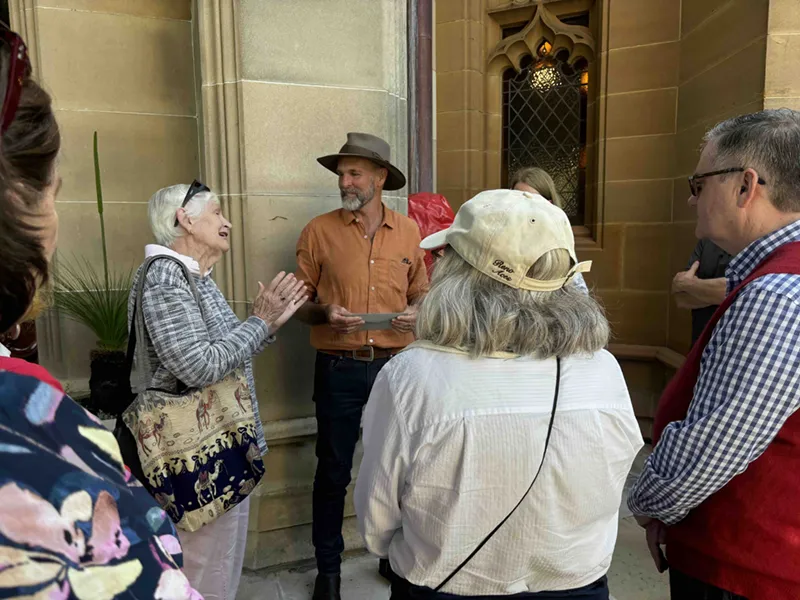
Eleven New South Wales members and non-members hugely enjoyed their private tour around the grounds of historic Government House, Sydney with recently appointed Garden Curator, Rick Shepherd (formerly Head Gardener at Retford Park). It was a perfect Sydney spring morning. Bettina Gollnow reports.
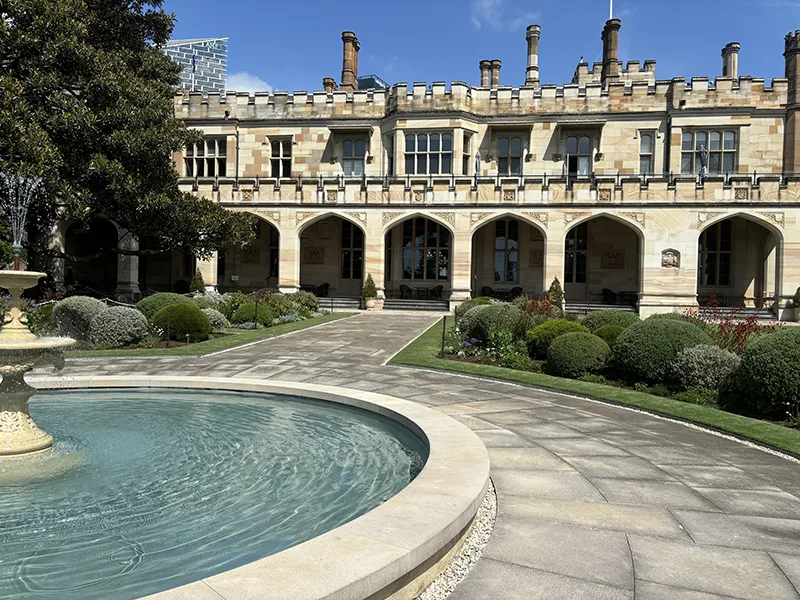
The garden, one of the oldest continually maintained gardens in Australia, covers five hectares beside Sydney Harbour and comprises private gardens as well as formal open areas. Government House is the Official Residence and Office of Her Excellency the Honourable Margaret Beazley AC KC, 39th Governor of New South Wales.
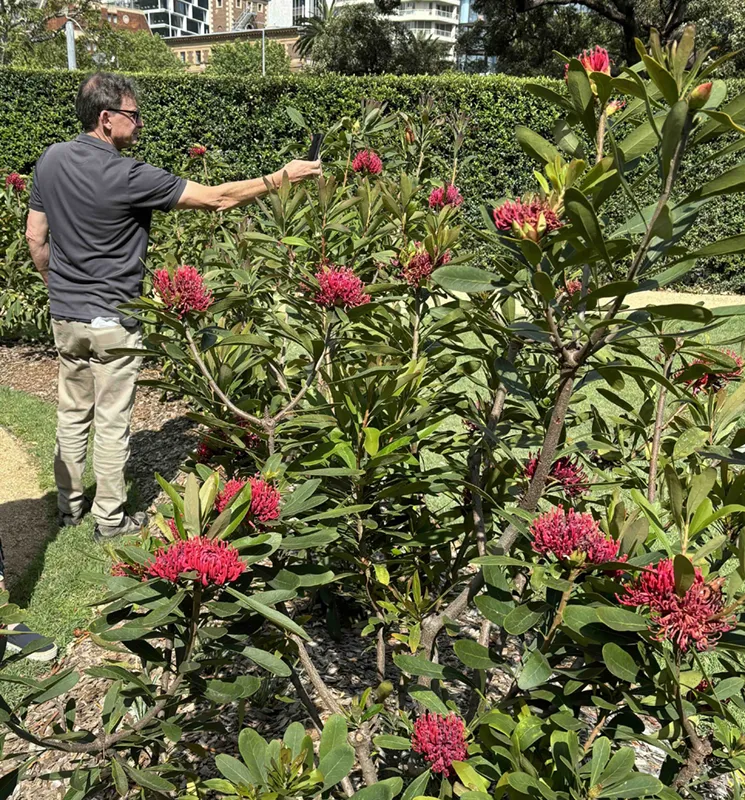
A highlight for me was to see the relatively new waratah garden. Rick explained this was a ‘COVID project’ envisioned by Her Excellency who felt it would be fitting for Government House to have a garden featuring the NSW state floral emblem.
The waratah garden is tucked away in a sheltered corner of the grounds as initially there were reservations that waratahs (Telopea spp.) could grow on the site. Early establishment was spearheaded by Sydney horticulturist and land scape gardener Jonathan Garner. To facilitate establishment, red basaltic soil was imported from Robertson in the NSW Southern Highlands (where waratahs thrive naturally in the bush and in commercial flower farms) and formed into mounded beds. Three selections were planted using advanced plants sourced from Proteaflora Nursery in Victoria.
When we visited in October, the plants were still flowering but also host to a population of white palm scale. Rick said their control and management is a challenge, both at Government house and in commercial flower plantations. He is trialing organic pest management solutions. With applications of Pestoil® failing to control the scales he is aiming to trial three biological control agents as well. The plants will be covered with a special mesh cage before the parasites and predators are released to ensure the beneficials stay put and focus on the scale pests.
As for pesticides, Rick explained his philosophy: “It’s like chocolate – I keep it on a high shelf and only reach for it if I must!”
As we wandered around the garden, Rick shared details of the history of the buildings and garden. The house itself was completed between 1837 and 1843.
We passed another ‘COVID project,’ which is the Western Terrace and involved more native plants. Here long-term plantings of azaleas have been replaced with a selection of Australian native shrubs.
We walked through some behind-the-scenes areas including the glasshouse where a selection of potted plants is nurtured to provide specimens to decorate the interior of the house.
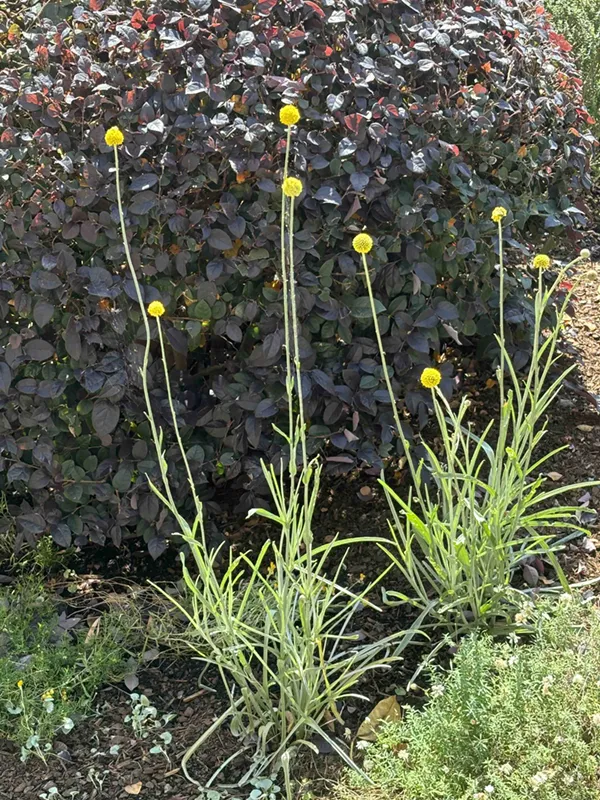
Nearing the front of the House with its magical harbour views, Rick outlined his efforts over the past year. He has ‘rescaled’ the height of the garden beds flanking the path leading to the central fountain and the harbour vista beyond. The challenge is to ensure the plants provide an attractive foreground without infringing on harbour views. Lower growing species have been planted – core plants are clipped into low mounds and interspersed with a visually interesting and colourful mix of various annuals and perennials. These include Australian natives such as flannel flowers (Actinotus helianthi) and billy buttons (Pycnosorus globosus syn. Craspedia globosa). Paper daisies (Xerochrysum bracteatum) also grow well in several of the gardens.
As we gathered in the shade of an enormous Moreton Bay fig that flanks the house on its south-east side, Rick explained that here there had been some gentle pruning to lift the canopy and allow more air flow and views of the harbour beyond. The tree has been underplanted with a mix of mainly foliage plants to add interest. The tree was planted soon after the house was completed and is the survivor of a pair that were planted on either side of the terrace at the front of the house.
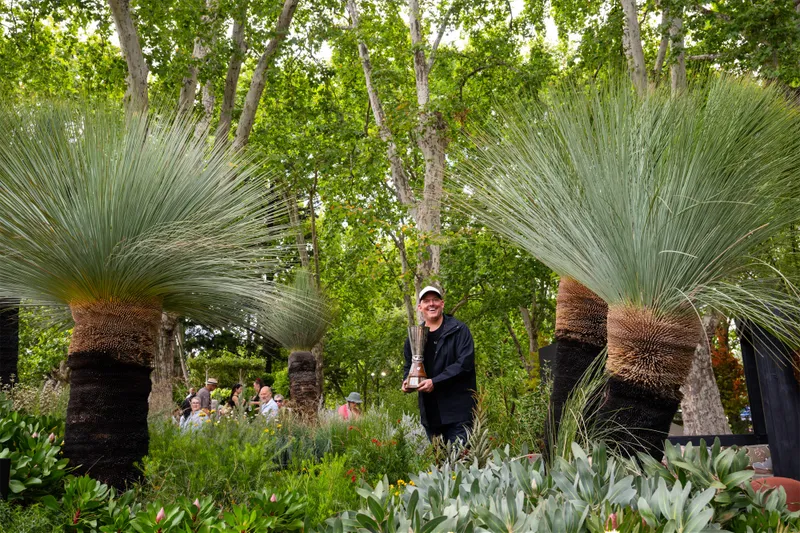
Also of interest were two potted grass trees (Xanthorrhoea spp.) that flank the main entrance door. Rick explained that because it is very shady there, there are two sets of these potted plants, and they are rotated every six weeks to allow plants time in the sun before returning to their prestigious location.
Many thanks to Rick for guiding us around and answering all our questions(!) and to Toni Salter for organising the outing.
About the author: HMAA member Bettina Gollnow, currently Communications and Extension Manager with WildFlowers Australia, is an extension horticulturist with over 30 years of experience of working with the Australian cut flower industry.