
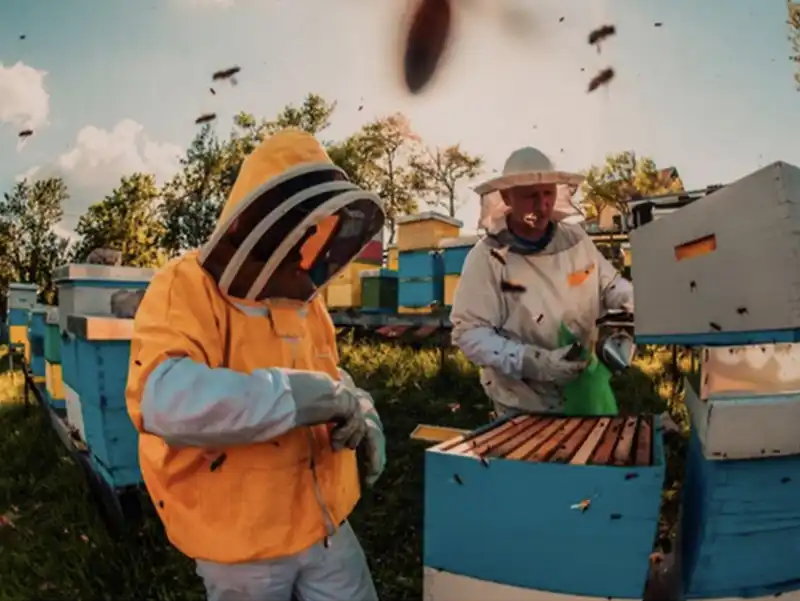
Bees inadvertently collect other substances in the environment when going for pollen. That makes them good indicators of the presence of pesticides, according to a Wageningen study. The report was published in Wageningen World in December 2025.
Researchers from Wageningen University & Research (WUR) looked at 315 beehives from all over Europe and detected 188 pesticides, including the banned insecticide imidacloprid. The beehives were sampled in summer 2023 and screened for over 400 different pesticides. All the hives had some traces of pesticides.
To demonstrate the presence of the substances in the beehives, plastic strips covered with a layer of material that binds volatile compounds were suspended in the hives for two weeks.
The principle that bees could be used as biomonitors had already been demonstrated nine years ago by the Wageningen bee researcher Sjef van der Steen. His method formed the basis for this European monitoring project.
“To a large extent, the products we found match what is used in agriculture,” says Ivo Roessink, a researcher at Wageningen Environmental Research. But the pesticide imidacloprid was found in one in three hives, despite having been banned from use in field crops for the past 10 years.
Imidacloprid is still used in pet flea products. Other banned insecticides, such as thiacloprid and chlorpyrifos, were also found. Even residues of the notorious DDT were detected in one in four hives, albeit in very low concentrations. That product has been banned for nearly 40 years.
The bee monitor shows whether a pesticide is present in the environment, but not in what concentrations.
“That substance comes from the surrounding area and could have been brought in by a couple of bees or thousands. So you can’t deduce from this what the exposure is in the environment,” Ivo Roessink explained. The bee monitor provides qualitative information, which Roessink says can supplement the existing monitoring projects.