A recent issue of the Proceedings of the National Academy of Sciences contained an article about a clever reproductive adaptation of climber. The findings were summarised in Live Science (livescience.com).
Sexually reproductive plants make berries in the hopes that hungry critters will swallow their seeds and poop them out far away, inadvertently spreading the species. Asexual plants, on the other hand, don’t produce seeds, leaving their offspring stuck close to home.
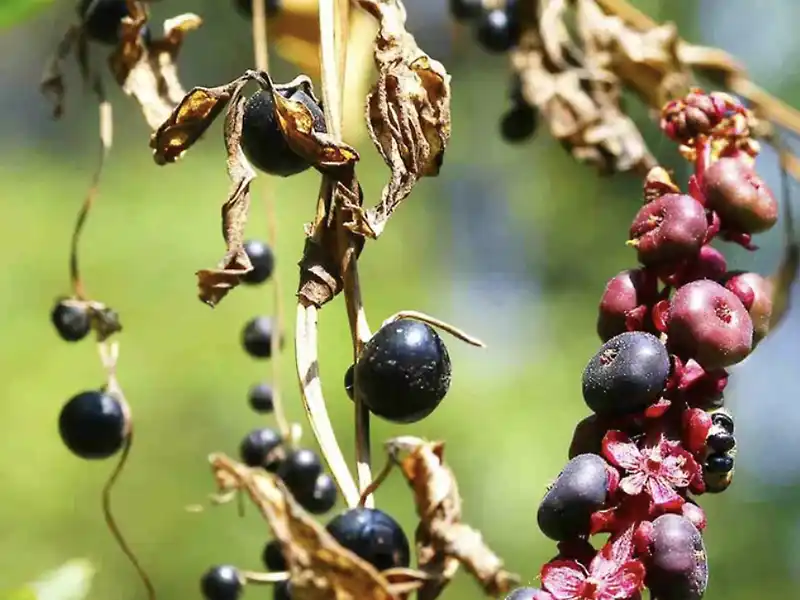
Now, researchers have discovered that the asexual yam Dioscorea melanophyma takes a leaf out of sexual plants’ book: it grows fake berries called bulbils. Instead of seeds, the glossy black buds contain genetically identical copies of their parent plant. Comparison to true berries of 27 other plants revealed that the bulbils matched their reflectance, colour, and size range, making them attractive to many birds.
Indeed, three years of camera observations revealed that 22 species of birds munched on the fake berries, especially in the winter when real fruits were scarce. When the team conducted bulbil feeding trials with a songbird, the fake berries passed through its digestive system relatively unscathed, leaving the tricksters viable for sprouting new yam plants while providing the hungry birds with little sustenance. “These results demonstrate a viable route by which loss of sex … can be offset by sensory deception,” the authors wrote. For most humans, at least, we’ll be thankful to buy our berries in the grocery store!

Berry clever reproduction